
Find out more
Everything MediWord gives you, in one place
A closer look at the question banks, revision notes, flashcards and live teaching that make up a MediWord subscription — and how it's different from a stack of PDFs and a generic quiz app.
What you get
One subscription, the whole toolkit
MediWord brings the question bank, flashcards, mock papers and live teaching together in a single platform, so revision time goes into practising rather than hunting for the next resource.
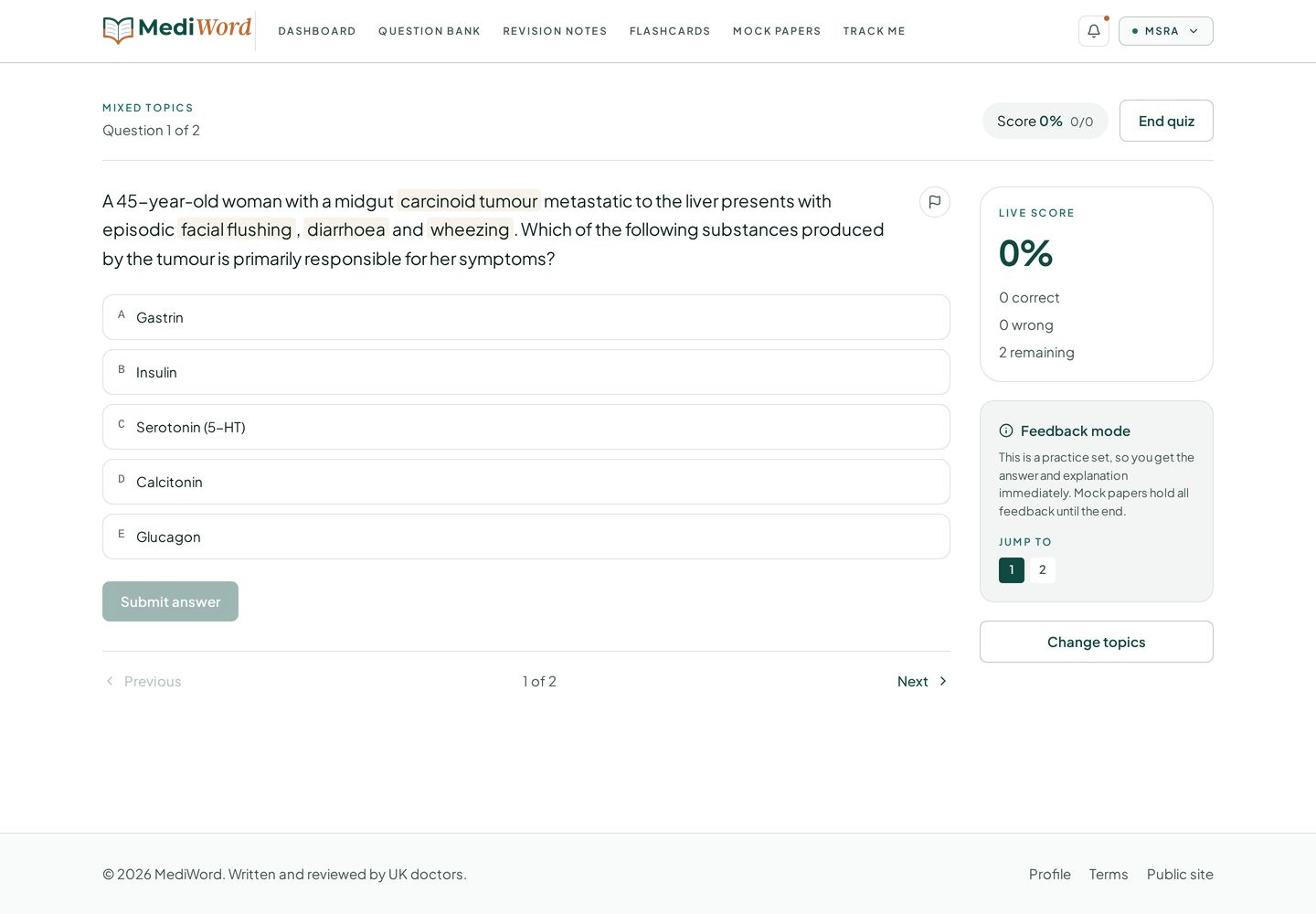
Recall-based question bank
Stems reconstructed from candidate recall, then rewritten and referenced by a doctor who scored in the top decile.
Guideline-referenced notes
Every explanation links to a dated, versioned note traced back to current NICE, SIGN or Royal College guidance.
Spaced flashcards
Questions you get wrong become flashcards on a spacing schedule, so revision arrives while it can still move your score.
Mock papers
Timed papers that mirror the live sitting, with per-topic accuracy rather than just a final score.
Track me
Predicted score and topic-level accuracy, updated after every session, so you can see your weakest topic this week.
Weekly live teaching
Free live sessions with the doctors who wrote the bank, recorded for members.
11,000+
clinically reviewed questions
1,900+
revision notes, each dated
24 hours
to a full refund, no questions
Every cycle
banks rewritten after each sitting
How it works
From sign-up to exam day
Sit questions written from real recall
Every stem is reconstructed from structured candidate recollections after a sitting, then rewritten and referenced by a doctor who scored in the top decile. Nothing is copied from the paper itself.
Read the note behind the answer
Each explanation links to the note it came from, dated, versioned and traced back to current NICE, SIGN or Royal College guidance, so you can see exactly what changed and when.
Come back before you forget
Questions you get wrong become flashcards on a spacing schedule, so revision arrives while it can still move your score rather than the night before the exam.
Built around your exam
Every exam bank, tailored to its syllabus
Question banks, revision notes and mock papers are written and reviewed exam by exam — not a generic bank reused across specialties.
MSRA
4,996 SBA-style questions, revision notes and timed tests aligned with the MSRA curriculum. Built for the Janu...
View exam page →UKMLA
5,303 questions mapped to the MLA content map, with explanations that cite GMC and NICE guidance.
View exam page →MRCS Part B
View exam page →MRCS Part A
5,442 questions across anatomy, physiology, pathology and surgical science, with diagrams and cited explanatio...
View exam page →Interview Bank
420 interview scenarios, model answers and portfolio guidance for CT1/ST1 specialty interviews.
View exam page →What students say
Trusted by students preparing right now
“I stopped rewriting notes. The question, the note and the flashcard were the same material, so revision finally felt like one thing instead of three.”
Dr A. Whitfield
GP trainee · MSRA 2026
“Every explanation cites the guideline. I stopped keeping a separate NICE tab open, the note was already there.”
Dr L. Okafor
Core surgical training · MRCS Part A
“I revised entirely from my phone on night shifts. Nothing got between me and the material, which is the whole point.”
N. Patel
Final year medical student · UKMLA
Questions
A few more things worth knowing
How long do I get access for? +
It depends on the exam: 6 months for MSRA and UKMLA, 12 months for MRCS Part A, 4 months for UCAT, and 3 months for the ST1 interview bank. The exact period is on each exam's page before you pay.
Can I use MediWord on my phone? +
Yes. MediWord is a native iOS and Android app, and the same account works in the browser. Questions, notes and flashcards download for offline use.
Do you offer group or deanery licences? +
Yes. Email us with the number of seats and the exam, and one of the two of us will reply with a quote, usually the same day.
Who writes the questions? +
Named UK doctors who have sat the exam, each question is reviewed by a second clinician before it publishes.
What happens if I think a question is wrong? +
Use the feedback box on the question. It goes straight to a named editor, who replies and, if the item is wrong, fixes it and records the change.
Are your questions recalled from real exams? +
Stems are reconstructed from structured candidate recollections after a sitting, then rewritten and referenced by a doctor. Nothing is copied from the paper itself.
Ready to see it for yourself?
Create a free account, or go straight to plans for your exam.